
Dhaka’s Waste Crisis Emerges as a Silent Urban Disaster
Rapid urbanisation and weak waste systems are leaving Dhaka’s streets, drains and waterways increasingly burdened by waste.
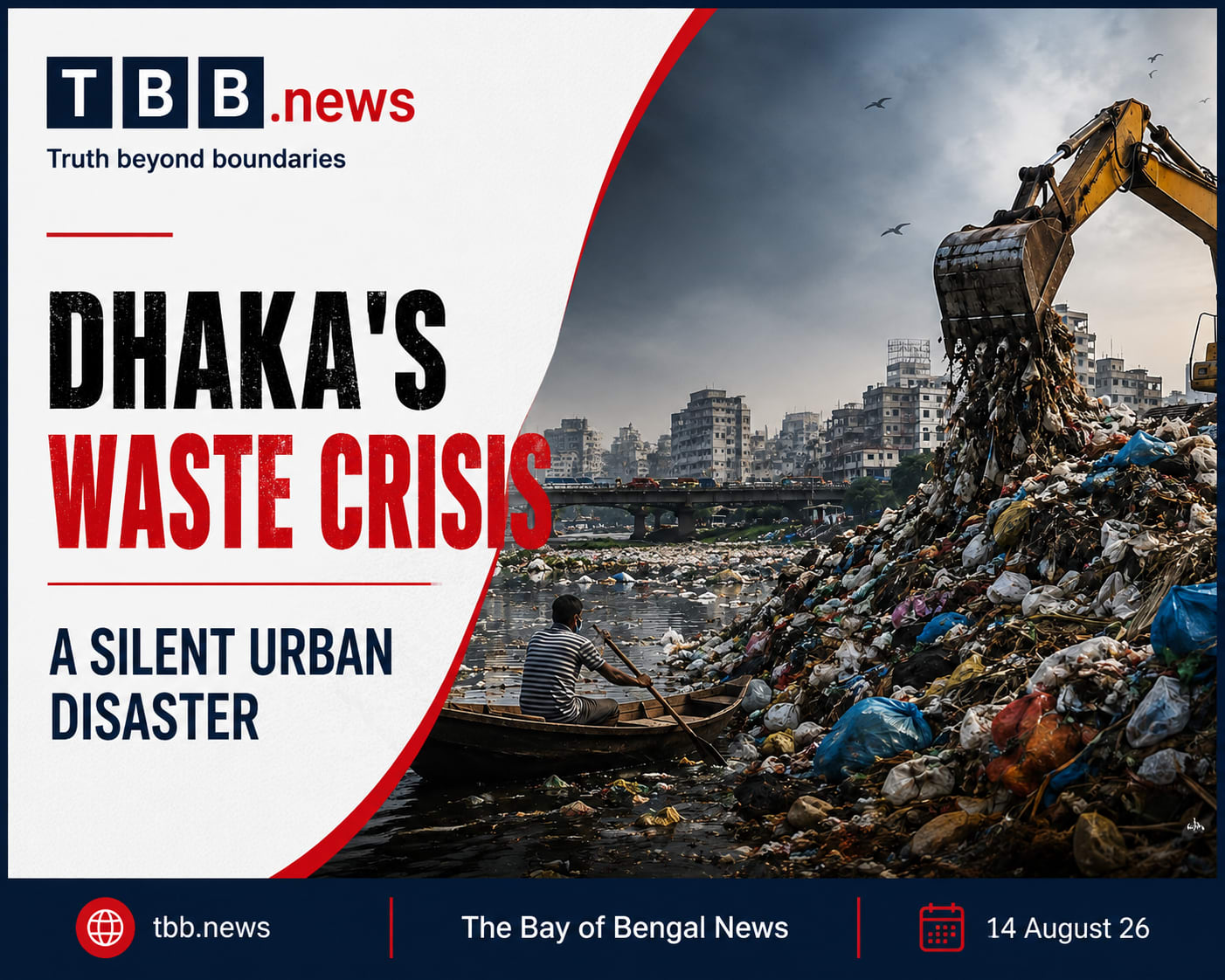
Dhaka is facing a growing waste-management crisis as rapid population growth, inadequate collection systems and weak coordination leave thousands of tonnes of solid waste unmanaged every day. The capital, home to more than 20 million people and Bangladesh’s economic and political centre, is generating an estimated 6,500 to 7,500 metric tonnes of solid waste daily, with the figure expected to reach 8,500 tonnes by 2032.
A growing waste burden
The scale of the problem is reflected in collection rates. According to older survey data, only about 37% of Dhaka’s waste was collected in 2019-20, leaving large quantities to accumulate in unauthorised locations, drains and open spaces or to be burned.
Across Bangladesh, daily waste generation is estimated at around 25,000 tonnes, while about 55% of urban waste is reportedly left uncollected. Per-capita waste generation in Dhaka also rose from 0.575 kilogrammes a day in 2017-18 to 0.72 kilogrammes in 2019-20.
The Dhaka North City Corporation and Dhaka South City Corporation operate 118 temporary secondary transfer stations combined. Waste is transported to major disposal sites including Aminbazar, Matuail, Beribadh and Uttara.
Estimates cited in waste-management discussions indicate that around 4,500 tonnes of solid waste enter the Buriganga River every day. Dhaka also generates about 4,820 tonnes of electronic waste annually, with no effective formal system capable of managing the entire volume.
Why the system is struggling
Rapid and unplanned urbanisation has outpaced the development of waste infrastructure. New residential areas, markets and industrial establishments have expanded quickly, while collection, transportation and disposal systems have failed to keep pace.
Waste segregation at source remains limited. Most households and institutions do not consistently separate organic and inorganic waste, making recycling, composting and reuse more difficult.
Institutional coordination is another major weakness. City corporations, the Department of Environment, water authorities and other agencies share responsibilities related to urban services and environmental protection, but gaps in coordination often weaken implementation. Although policies such as the National 3R Strategy introduced in 2010 exist, enforcement and monitoring remain inadequate.
Collection vehicles, workers and transfer facilities are also insufficient for the city’s needs. At the same time, irresponsible dumping by residents and industrial establishments continues to put additional pressure on the system.
Industrial and clinical waste create further risks when they are discharged without adequate treatment, contributing to chemical and biological pollution of waterways and surrounding communities.
Environmental and public-health costs
The consequences extend far beyond unpleasant streets and overflowing bins. The Buriganga has suffered severe pollution, while the Turag, Balu and Shitalakkhya rivers face similar pressures from untreated waste and wastewater.
Open burning of waste adds to Dhaka’s already serious air-pollution problem. Polluted waterways also threaten aquatic ecosystems and undermine the economic activities that once depended on healthy rivers.
Public health is another major concern. Around 4 million people living along polluted river areas are exposed to contaminated water and related environmental hazards. Exposure to heavy metals can increase risks of kidney complications, neurological disorders and certain cancers, while polluted environments can contribute to waterborne diseases, skin conditions and respiratory problems.
Overflowing waste containers and poorly located transfer stations can occupy roads and footpaths, worsening congestion and making pedestrian movement more difficult. Persistent odours and unsanitary surroundings further reduce the city’s quality of life.
The economic impact is also significant. The Buriganga once served as a major centre of trade and transport, while fishing communities depended on its waters. Pollution has increasingly undermined both the river’s environmental value and its economic potential.
The way forward
Experts and urban planners have long argued that Dhaka needs a shift from conventional dumping towards integrated waste management. Key measures include:
Mandatory separation of organic and inorganic waste at source.
Expansion of sanitary landfills and carefully planned waste-to-energy projects.
Digital monitoring of collection and transportation to strengthen transparency and accountability.
Formal recognition, training and safety support for informal recycling workers.
Stronger enforcement against untreated industrial and clinical waste disposal.
Better coordination among city corporations, environmental authorities and the central government.
Sustained public-awareness campaigns through schools, media and local communities.
Dhaka’s waste crisis is no longer simply a municipal-service problem; it is a growing environmental, health and urban-livability challenge.
Conclusion
Dhaka’s waste-management crisis has developed over years and cannot be solved overnight. But stronger planning, appropriate technology, institutional accountability and responsible citizen behaviour can reverse the trend.
Without immediate and coordinated action, rising population and waste generation could push the capital into an even deeper crisis over the coming decade. Managing waste effectively is therefore not only about keeping streets clean; it is essential to protecting Dhaka’s rivers, public health, economy and future as a liveable city.
How did this land?
Related reporting
Dhaka's Air Pollution: The Capital in the Grip of a Silent Killer
Experts warn that seasonal improvements in Dhaka’s air quality may reverse without stronger controls on emissions and dust.

Battery-powered rickshaws: A complex policy equation for Bangladesh
The rapid growth of battery-powered rickshaws is creating interconnected pressures on electricity, the environment, public health and livelihoods.

Bangladesh Plans New Measles Catch-Up Campaign as Toll Passes 1,000
Bangladesh is preparing another measles-rubella vaccination drive as more than 171,000 suspected cases expose persistent immunity gaps.

Dhaka’s Utility Crisis Deepens as Jurain and Shyampur Residents Protest Shortages
Residents in South Dhaka demand reliable gas and electricity after prolonged disruptions disrupt daily life and local businesses.